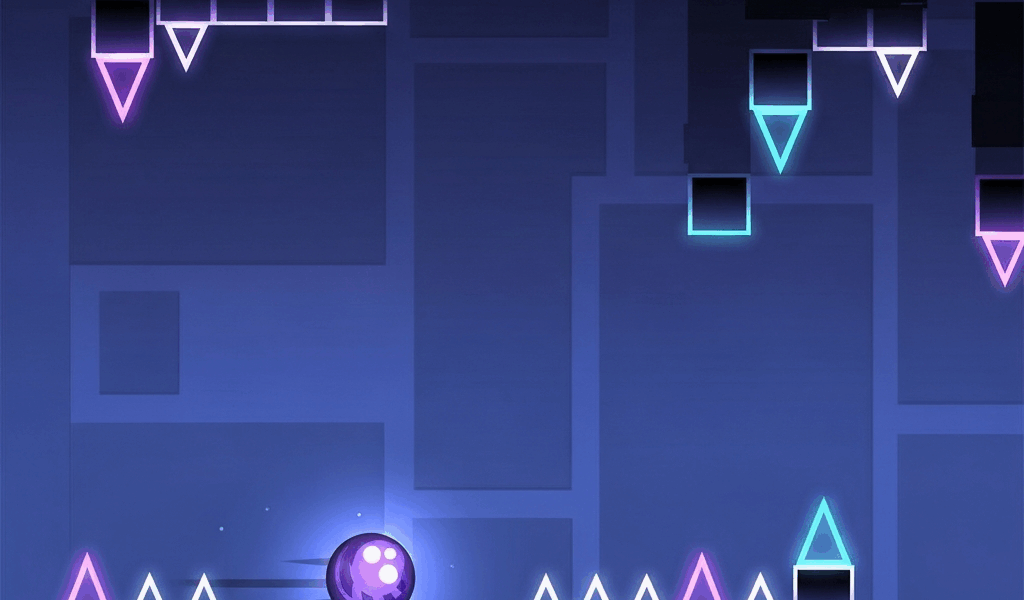
Ball mode has gotten a bad reputation with all the complaints about it flying around the community. As someone who spent the better part of a year being genuinely mediocre at it, I know exactly what those complaints feel like. My cube sections were solid. Ship was improving. But ball mode was consistently my worst area — dying in places I had no business dying, with no clear explanation why. Today I’ll share everything I figured out about it.
The problem wasn’t my reaction time. It was that I didn’t understand what ball mode was actually asking me to do differently from cube.
What Makes Ball Mode Different From Cube
New players treat ball like a slower, rounder cube. The input looks similar — tap to change something about your movement — but the underlying physics are completely different.
Cube jumps carry momentum from the ground. Ball mode flips your gravity relative to whichever surface you’re rolling on. When you tap in cube mode, you leave the surface. When you tap in ball mode, you switch surfaces. The ball rolls along whatever surface the new gravity pulls it toward.
That distinction changes how you read obstacles. In cube mode you’re reading gaps in the floor. In ball mode you’re reading the relationship between the ceiling and floor simultaneously, because both are potential rolling surfaces. I
Why You’re Dying Where You’re Dying
Most ball mode deaths fall into three categories.
Late gravity flips: You see an obstacle, recognize you need to flip, and tap just after the right moment. Ball mode requires earlier input than you instinctively think — tap as you approach the trigger point, not when you reach it.
Forgetting which surface you’re on: Extended sections with multiple rapid flips create orientation confusion. I lost track constantly early on. Keep a visual anchor on your ball’s actual position rather than mentally counting flips.
Orb timing in ball mode: Yellow and blue orbs interact with gravity in ways that feel counterintuitive until you’ve seen them enough times. Yellow orbs push you upward regardless of current gravity. Blue orbs reverse it. Practice sections with mixed orbs slowly until those interactions feel natural.
The Mini Ball Problem
Mini ball is harder than regular ball for most players, not because the inputs change but because the smaller hitbox makes everything feel less forgiving. Gaps that look clearable are tighter than they appear. When a level transitions you into mini ball, treat it as a new section requiring immediate recalibration.
How to Practice Ball Mode Effectively
Play the main levels specifically for the ball sections they contain. Hexagon Force has a well-known dual-ball section that has trained a lot of GD players over the years — Use practice mode on that section until the gravity-flip timing feels automatic rather than conscious.
In the creator community, search for dedicated ball mode practice levels. They isolate ball gameplay and force mode-specific skill development without other game modes interrupting your focus.
Ball mode has a reputation for being tricky, but once you understand it’s about surface relationships rather than gap-reading, specific failures start making sense. That understanding is the difference between random deaths and fixable ones.
Related Articles
Continue reading:

Leave a Reply