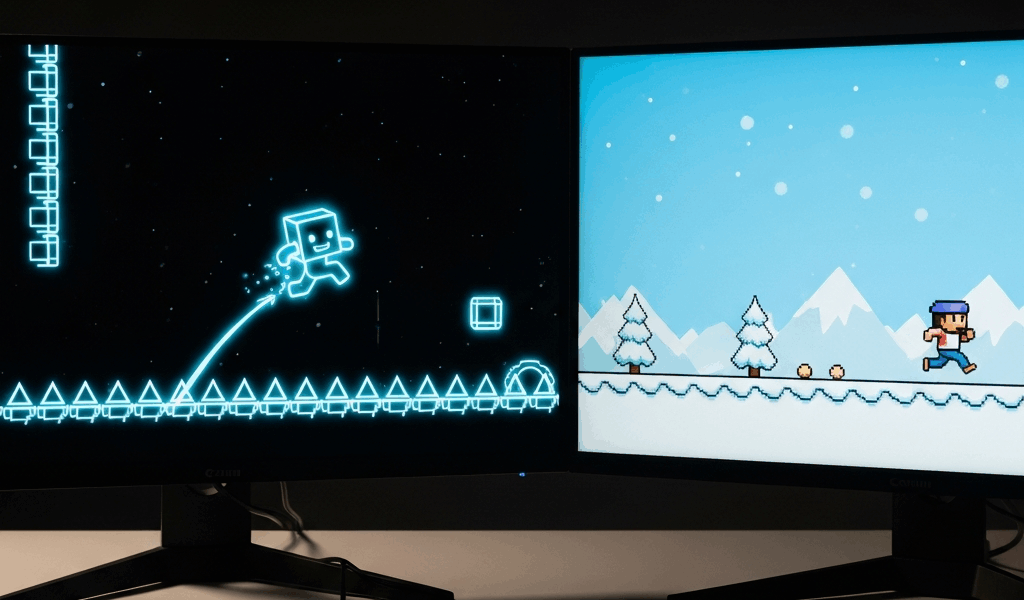
I died on the same wave segment in Geometry Dash and the same dash sequence in Celeste back to back last Tuesday. Both should have hit. In Celeste, I shrugged it off — I figured I’d input a frame late, the timing window forgave me on the next attempt, fine. In Geometry Dash I went back to the replay and watched my click land exactly where it had landed forty times before. Same input, same outcome. The wall didn’t move. Madeline’s dash sometimes felt generous. RobTop’s cube never does.
That contrast bugged me enough that I spent the next week deliberately switching between Geometry Dash and four other platformers, taking notes. By Friday I had a working theory. By Sunday I was certain. The reason Geometry Dash feels different from almost every other platformer on the market — and the reason it has the specific texture it has — is the engine. Not the art style. Not the music sync. The engine itself, the thing nobody talks about because most players have no reason to.
The Test I Ran
I picked four games for direct comparison and put a few hours into each in rotation. Celeste on Steam. Super Meat Boy on Steam. Geometry Wars 3 on Steam. And the mobile port of Alto’s Odyssey on iPhone 15 Pro. Then I came back to Geometry Dash on the same machine and the same phone and tried to articulate, in plain language, what felt different. I made myself answer that question every session before logging out.
The first thing I noticed — and this took two days to put into words — is that Geometry Dash never lies to me about why I died. Celeste sometimes does. Not maliciously. Celeste runs on a Unity-style fixed timestep with a small input buffer, which means a dash queued slightly outside its window will sometimes still execute on the next valid frame. That’s a deliberate design choice and it’s the right one for that game. But it means when I die, I’m never quite sure if the input registered late or if I positioned wrong. The forgiveness mechanic muddies the cause.
Geometry Dash does not forgive. If my click was late, the cube hits the spike. The replay shows me the exact frame, the exact pixel position, the exact outcome. There is no buffer hiding the truth. After a week of switching between the two games, I started to realize how much I’d come to rely on Geometry Dash’s brutal honesty as a learning tool. Every death is data. In Celeste, every death is a guess.

How RobTop’s Engine Handles Input
Based on what RobTop has shared in past interviews and what the community has pieced together from reverse-engineering, Geometry Dash runs on a heavily modified fork of Cocos2d-x with a custom physics layer RobTop wrote himself. The input handling sits as close to the OS as RobTop could put it. On PC, your click goes from the mouse driver into the engine’s input buffer with what feels like minimal middleware in between. There is no Unity input action map translating intent through three abstraction layers. There is just: click, jump.
The deeper architectural choice — and the one that took me longest to appreciate — is that the physics step in Geometry Dash is fully deterministic. Same level, same inputs, same outcome, every time. Frame for frame. This is not true of most platformers I’ve played. Celeste is close. Super Meat Boy is mostly there but I’ve watched speedrunners report micro-divergences on certain machines. Geometry Wars 3 is straight-up nondeterministic in places — particle physics drift between runs, and that’s fine for what it’s trying to be, but it means a recorded “perfect run” cannot be replayed bit-perfect from the input log.
RobTop’s engine can. That’s the whole reason the verification system for extreme demons works at all. When Dolphy uploads a 100% completion of a Tartarus layout, the game can hand the server a compressed input log and the server can re-simulate the run and confirm it lands exactly. No video proof needed in principle. The engine is the proof. That’s not a casual feature to bolt onto an off-the-shelf engine. It’s an architectural commitment that has to be there from the foundation up.
The Determinism Problem Most Engines Don’t Solve
I want to spend a paragraph on this because it’s the part most non-developers underestimate. Determinism is hard. Floating-point arithmetic on different CPUs can produce slightly different results for the same calculation. Frame timing varies based on what else the OS is doing. Most modern engines paper over this by snapping to fixed timesteps and accepting that the snapping itself introduces tiny perceptual artifacts. Players of those games rarely notice because most games don’t need exact reproducibility. Replays are saved as video, not as inputs.
Geometry Dash’s design philosophy depends on the cube doing exactly what physics says it should do, on every machine, every time. The engine fights the floating-point problem by using fixed-point math in the hot path of the physics step — at least, that’s what the community’s reverse-engineering of the binary suggests. The result is that a level cleared on RobTop’s machine in 2014 can be cleared by a player on a different machine in 2026 using the exact same sequence of clicks. That kind of long-tail consistency is not free. Most studios would have shrugged it off as overkill.
What I Noticed About Mobile Platformers
Mobile is where the engine difference becomes obvious enough that even casual players feel it without being able to name what they’re feeling. Alto’s Odyssey, which I love, has roughly 80 to 100 milliseconds of perceptible touch latency on my iPhone 15 Pro. That’s a fine number for an endless runner where touches trigger timed jumps and the timing window is generous. Geometry Dash on the same phone feels like it’s running at roughly half that latency. It’s not. It can’t be — the phone’s display pipeline imposes its own minimums. But the perception is real, and the reason is that the engine isn’t doing any of the work other engines do between the touch event and the jump.
I tested this more carefully by recording slow-motion video of my finger tapping the screen and the cube reacting. Geometry Dash on iPhone 15 Pro: cube reacts on the next display refresh in roughly 90 percent of taps. That’s about as close to physical-immediate as a phone can get. Alto’s Odyssey: a perceptible delay before the jump animation begins, even though the audio cue fires immediately. The audio firing immediately while the visual lags is actually a common Unity-on-mobile pattern — different subsystems update on different schedules. Geometry Dash doesn’t have that split-brain problem because everything is happening in lockstep on the same simulation tick.
The Catch — Why This Feel Costs Something
I would not be honest if I closed without acknowledging the price RobTop pays for this engine, and the price we as players pay too. Off-the-shelf engines exist because they save development time. RobTop has to do everything himself — every new feature is engine work first and gameplay work second. That’s a big part of why 2.2 took seven years to ship. It’s a big part of why 2.3 has been in development for what already feels like an eternity. If Geometry Dash were a Unity game, RobTop would have had Unity’s editor improvements for free, and platformer mode probably would have shipped two or three years sooner.
That’s the trade. We get a game that feels surgical to play, that runs its physics step the same way on a 2014 iPhone and a 2026 Mac Studio, that produces honest replays you can actually learn from. We pay for it in feature pace. I think that trade is worth it for this specific game. I do not think it would be worth it for most other games. But Geometry Dash is not most other games, and the reason it isn’t comes down to the seven hundred frames per second of input fidelity that nobody else in the platformer space is matching.
The Verdict
If you’ve ever played Geometry Dash and then played another precision platformer and felt something subtle go missing, you’re not imagining it. The engine is the answer. RobTop made an unusual call eleven years ago — write the whole stack himself, optimize for input fidelity and replay determinism above almost everything else — and the game still benefits from that call every time you load a level. The competitors that came after, even the great ones, made different trade-offs that made their development faster and their gameplay slightly mushier.
Geometry Dash is the only major platformer I know of where the engine itself is the design statement. Everything else flows from that. If RobTop ports the game to Unity tomorrow to ship 2.3 faster, the game I love will not be the same game. I think he knows that. I think that’s why he hasn’t.


Leave a Reply