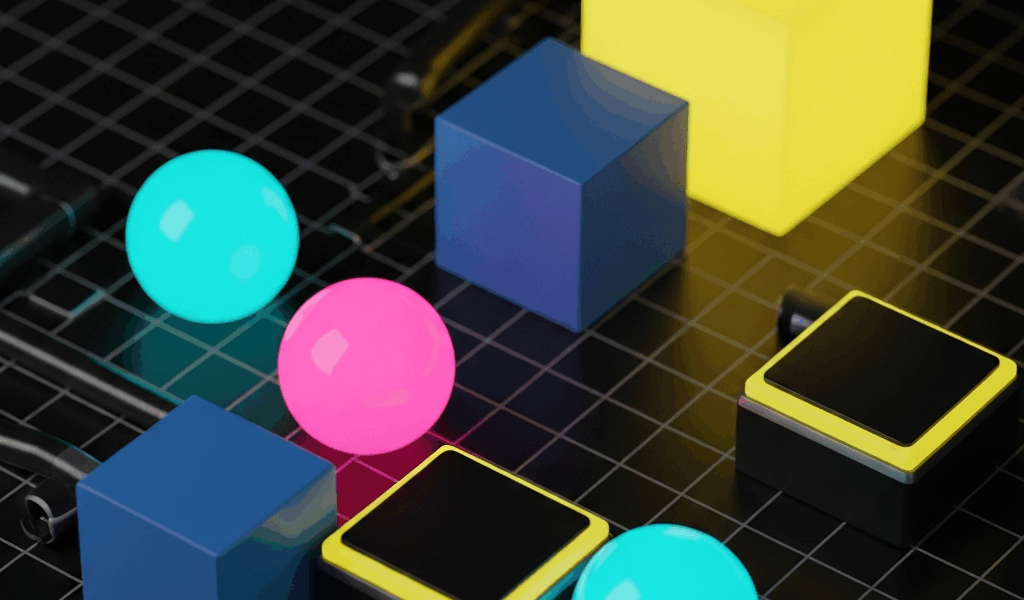
The Two Categories — Orbs (Tap) vs Pads (Auto)
Geometry Dash has gotten complicated with all the mechanics flying around, and honestly, the first thing that tripped me up when I was learning was understanding the difference between orbs and pads. They look completely different, they function completely different, but beginners tend to lump them together. Let me break down what actually separates them.
Orbs require your input. You tap them. The moment your ship or cube or wave touches an orb, nothing happens unless you press the jump button — or click the mouse, or tap the screen, depending on what you’re playing on. This is the critical part. An orb just sits there waiting for your action. Yellow orbs give vertical boosts. Blue orbs send you sideways. Green orbs let you dash in mid-air. Pink orbs are teleport tools. The list goes on and on. But they all share one thing: they do nothing on their own.
Pads are automatic. You hit a yellow pad and your character bounces up immediately. No input required. No waiting around. This fundamental difference changes how level creators design sections. An orb section tests your timing and reaction speed. A pad section tests your positioning and rhythm prediction.
I’m apparently the type who overthinks these things, and honestly, most new players understand this difference within their first hour. But it’s the foundation for everything that follows, so it matters.
Every Orb Type — Color, Effect, and When Creators Use It
Yellow orbs are the baseline. They’re vertical jump boosts — when you tap a yellow orb, your character shoots upward. The strength depends on the orb’s size, but standard yellow orbs give you roughly the same height as a double-tap jump, maybe slightly higher. I see them everywhere because they’re versatile — jump sections, spike dodges, platform puzzles. They’re the bread and butter of Geometry Dash design.
Blue orbs push you horizontally. Left or right. The direction depends on which side of the orb you approach from. Creators use these for wave sections that need manual control, or for dodging obstacles that require precise sideways movement. They’re less common than yellow orbs, but they appear in almost every medium-difficulty level at some point.
Green orbs are the dash orbs that confused me for years — seriously, like five years of confusion. You tap a green orb and your character gains a sudden horizontal speed boost. Unlike blue orbs, which launch you in a direction and let gravity work, green orbs accelerate you forward. In a spaceship level, a green orb makes you shoot faster. In a cube level, it pushes you right. The effect stacks with your current velocity, which makes timing tricky. I learned this by failing the same section approximately 47 times, and that’s not an exaggeration.
Pink orbs are teleporters. Tap a pink orb and you vanish, reappearing at a designated pink pad somewhere else in the level. Creators love these for maze sections or for creating the illusion of impossible jumps. The pink pad’s location determines where you land. Getting the exit position wrong means a sudden teleport into a spike, so level design around pink orbs has to be extremely precise — like, pixel-perfect precise.
Red orbs are bounce orbs with a twist. They launch you in a specific angle — usually around 45 degrees — regardless of your current velocity. In wave mode, a red orb can redirect your entire trajectory. Bosses and extreme demons use red orbs constantly because they force unpredictable movement patterns. The player has to memorize the angle and time the tap accordingly.
Black orbs are rare. They’re invulnerability orbs. Tap a black orb and you become immune to spikes for roughly two seconds. You can see through them, pass through them, hit them with no consequence. These appear in custom levels and some extreme demons where spike gauntlets would otherwise be impossible.
Dash orbs deserve their own section because of how much confusion surrounds them.
Green vs Pink Dash Orb — The Difference That Confuses Everyone
This distinction actually matters. Confronted by dash orbs in a level I was trying to beat, I kept swapping them in my head because they look similar and the naming is unintuitive — at least if you’re new to the game.
A green orb is a dash orb that accelerates you horizontally. You tap it, your forward speed increases. In cube sections, you move right faster. In spaceship sections, you climb faster. The green color signals horizontal acceleration. It’s consistent. Fast movement forward.
A pink orb is teleportation. It’s not a dash orb at all in the speed sense — it’s categorized separately in most contexts because it does something completely different. You tap it, you vanish and reappear elsewhere. The name “pink dash orb” sometimes appears in guides, which is where the confusion starts. Pink orbs don’t dash anything — they transport.
If you’re looking at a level and seeing a green and pink orb side by side, the green one will boost your speed. The pink one will move you across the map. Different tools for different sections. Different timing requirements. Different practice strategies.
Every Pad Type — Color, Effect, and Timing
Yellow pads are basic bounce pads. You land on one, you bounce up. No input required. The bounce height matches a standard jump, so substituting a yellow pad for a yellow orb usually works in level design. The difference is automatic versus manual. Creators use yellow pads when they want rhythm-based sections where the player bounces to a beat.
Blue pads send you sideways automatically. Unlike blue orbs, which only work if you tap them, blue pads trigger on contact. This makes them useful for synchronized movement sections. If you’re bouncing on yellow pads in rhythm and need a sudden sideways movement, a blue pad does it without player input, which keeps the rhythm flowing.
Pink pads are landing zones for pink orbs. When you teleport from a pink orb, you land on a pink pad. That’s their primary function. But some creators use pink pads as regular jump pads that teleport you if you hit them again, creating bouncy teleportation chains. A standard pink pad is just a destination, though.
Red pads bounce you at a fixed angle, usually around 45 degrees, just like red orbs. But red pads trigger automatically, so creators can design predictable angled bounce sequences. You know exactly where you’ll be after each red pad. In wave levels, red pads create spiraling climb sections. In cube levels, they create zigzag paths.
The cosmetic skin pads don’t have special effects — they’re visual variations of existing pad types. Same function, different appearance. I bought them early on thinking they’d unlock new mechanics. They don’t. They just look different.
Orb and Pad Timing Tips — How to Hit Them Consistently
Timing orbs and pads correctly separates casual players from people who can actually beat demon levels. Don’t make my mistake of ignoring these details.
Audio cues matter more than you think — seriously, they matter a lot. Geometry Dash has a distinct sound for each orb and pad type. Yellow orbs have a particular chime. Green orbs have a different pitch. If you practice with the game sound on, your brain starts predicting the timing before your eyes register the visual. I turned my volume off once to reduce distractions and immediately started missing orbs I usually hit. The audio is a timing guide your brain relies on more than you realize.
Visual positioning is mechanical. Orbs and pads always trigger when your character’s hitbox touches them. Practice mode is essential — play a section 20 times in slow-motion at 0.5x speed and you’ll see exactly where your character needs to be. The visual location matters less than you think — the hitbox is what counts. I wasted weeks trying to align my character’s center with an orb when I should have been watching my hitbox edges.
Green orbs and pink orbs require different practice approaches. Green orbs need rhythm practice — jump at the right millisecond or you miss the dash boost or you crash into a spike immediately after. Pink orbs need spatial memory. You tap a pink orb in one room, teleport to another, and need to know exactly where you’re landing. Practice pink orbs by teleporting from the same orb to the same pad 50 times until the landing position is automatic.
Tap timing versus release timing — some players hold down the jump button on an orb, and some tap and release. For most orbs, holding or tapping produces the same result, but green orbs are sensitive to this distinction. A clean, quick tap on a green orb feels different than holding the button. Find which works for you and stay consistent. I switched tap styles mid-level and started failing sections I’d previously beaten.
Pad timing is straightforward because pads don’t require input — you just need to hit them. But hitting them at the right angle matters. If you’re supposed to land on a yellow pad and instead clip it from the side, you might bounce unpredictably. Practice sections involve literally running the same path over and over until your position is pixel-perfect. When you land on every pad in the same spot every time, the level suddenly feels easier.
Speed sections are different. Creator-made levels sometimes include “spam” sections with dozens of orbs packed closely together. In a spam section, you’re tapping orbs as fast as your device lets you. Reaction time is everything. Your fingers need to move faster than your brain can consciously process. I practice spam sections with my phone’s accessibility speed settings — faster tapping rates train muscle memory faster than conscious clicking.
Memorization is the real skill. Every level is deterministic. The orbs and pads don’t move. The spikes don’t move. Once you’ve beaten a section, you memorize exactly when each tap happens. The first 50 attempts are about learning. The next 200 are about muscle memory. By attempt 300, you’re executing the same sequence without thinking.
Red orbs and red pads require angle prediction. If you see a red orb launching you at 45 degrees into an obstacle, you need to predict where you’ll be and whether you’re safe. These are harder than other orb types because the 45-degree bounce often feels unintuitive — at least it did for me. Practice by spawning red orbs in practice mode and watching your trajectory repeatedly. Your brain needs to recalibrate what a 45-degree bounce looks like.
Black orbs change everything because they remove spike damage temporarily. If you’re bouncing through a spike gauntlet with black orbs protecting you, the timing isn’t about avoiding spikes — it’s about exiting the black orb’s invulnerability window before the next hazard. The orb gives you a time window, and you need to use it efficiently. I usually fail these sections by panicking and hitting a spike right after invulnerability ends.
Finally, the hardest part: consistency. You can hit an orb nine times perfectly and fail the 10th with no explanation. This is normal. It’s frustration. Every experienced player in Geometry Dash has a level they’ve beaten 100+ times but still occasionally fail. The variance is part of the game. Practice reduces it, but doesn’t eliminate it.

Leave a Reply