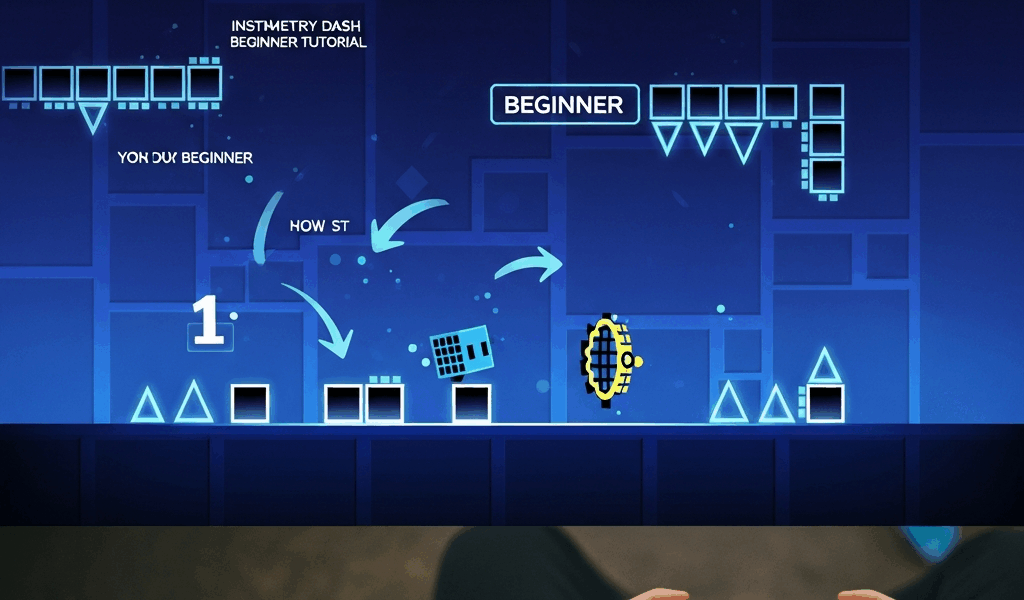
What Is Geometry Dash?
Geometry Dash is a rhythm-based action platformer developed by Robert Topala (RobTop) that released in 2013. The core gameplay is deceptively simple: your icon moves forward automatically, and you tap to jump, fly, or activate various game modes to avoid obstacles. The catch? Everything syncs to music, obstacles come fast, and one mistake sends you back to the beginning.

The game features 21 official main levels, thousands of user-created levels ranging from trivial to seemingly impossible, and a progression system that rewards practice and persistence. Unlike many modern games, Geometry Dash offers no shortcuts. You cannot pay to skip levels or buy power-ups. Every completion represents genuine skill development.
Main Levels Progression: Stereo Madness Through Fingerdash
The 21 official levels serve as your training ground. They introduce game mechanics gradually while increasing in difficulty.
Beginner Tier (Levels 1-5)
Stereo Madness (Easy) – Your introduction to cube jumping, basic spike timing, and platform gaps. Expect 50-200 attempts on your first playthrough. Focus on learning the rhythm rather than memorizing obstacles.
Back On Track (Easy) – Despite being labeled “Easy,” this level trips up many beginners with its awkward jump timings. The infamous ship sequence at 68% has ended countless runs.
Polargeist (Normal) – Introduces the ship game mode properly. You will hold to fly upward and release to descend. The difficulty bump from previous levels is noticeable.
Dry Out (Normal) – Yellow jump pads appear here. These launch you automatically when touched, requiring you to time your approach rather than your jump.
Base After Base (Normal) – Gravity portals flip your world upside down. Managing reversed controls while maintaining rhythm is the main challenge.
Intermediate Tier (Levels 6-10)
Cant Let Go (Hard) – Your first “Hard” rated level combines everything learned so far with faster pacing. The wave game mode debuts here briefly.
Jumper (Hard) – Ball mode arrives. Tap to reverse gravity while rolling on surfaces.
Time Machine (Harder) – Speed changes enter the picture. The level alternates between normal speed and double speed.
Cycles (Harder) – Complex timing patterns throughout. Many players consider this their first significant wall. Budget 500+ attempts.
xStep (Insane) – The first “Insane” difficulty. Completing xStep marks a genuine milestone. The community often considers beating xStep as graduating from pure beginner status.
Advanced Tier (Levels 11-15)
Clutterfunk (Insane) – Possibly the most infamous skill wall among official levels. Expect 1000+ attempts.
Theory of Everything (Insane) – A 90-second marathon testing endurance alongside skill. The robot mode debuts.
Electroman Adventures (Insane) – Fast-paced throughout with memorable music.
Clubstep (Demon) – Your first Demon level. Many players save this for later, which is completely valid.
Electrodynamix (Insane) – Primarily mini-mode gameplay with tiny icons.
Expert Tier (Levels 16-21)
Hexagon Force (Insane) – Dual mode throughout much of the level.
Blast Processing (Harder) – A good confidence builder after the grind of earlier Insane levels.
Theory of Everything 2 (Demon) – A longer, more demanding sequel. The spider mode debuts here.
Geometrical Dominator (Harder) – Prepares you for the final levels without crushing difficulty.
Deadlocked (Demon) – The final Demon of the original level set.
Fingerdash (Insane) – The most recent official level. Introduces swing copter mode.
Understanding the Difficulty System
Standard Difficulties
Auto – Requires no input. The level plays itself.
Easy – Simple jumps, slow speed, forgiving timing.
Normal – Basic mechanics with some challenge. Most players complete within 100 attempts.
Hard – Requires actual practice. Expect 100-300 attempts while learning.
Harder – Significant challenge. 300-800 attempts is typical.
Insane – Demands real skill development. 500-2000+ attempts depending on the level.
Demon Difficulties
Easy Demon – Entry-level Demon. “The Lightning Road” and “The Nightmare” are classic examples. Expect 500-3000 attempts for your first.
Medium Demon – Notable step up. “B” and “Sidestep” are popular medium demons.
Hard Demon – Serious challenge. “Nine Circles” and “Fairydust” test advanced skills.
Insane Demon – Expert territory. “Windy Landscape” and “Acropolis” demand near-perfect execution.
Extreme Demon – The hardest rated levels. “Bloodbath,” “Cataclysm,” and beyond represent the ceiling of human capability.
First Week Goals
Days 1-2: Learn the Feel
Complete Stereo Madness. Focus on understanding how tap timing relates to jumps. Play through Back On Track even if you cannot beat it yet.
Days 3-4: Ship Control
If you haven’t beaten Back On Track, keep attempting it. Start Polargeist to practice ship mode specifically.
Days 5-7: First Completions
Aim to complete Stereo Madness, Back On Track, and Polargeist by week’s end. Start attempting Dry Out.
First Month Progression Milestones
Week 2: Mechanics Foundation
Complete levels 1-5 (through Base After Base). Start tackling Cant Let Go.
Week 3: Expanding Skills
Complete Jumper and start Time Machine. Ball mode should feel natural by now.
Week 4: Reaching Insane
Complete Cycles. Push into xStep. Your total star count should be around 30-50.
When to Attempt Your First Demon Level
Prerequisites
Before attempting your first Demon, you should have completed at least through xStep in official levels. You should be comfortable with all basic game modes.
First Demon Recommendations
The Nightmare by Jax – The classic first Demon. Short, learnable, and fair. Most players complete this in 500-2000 attempts.
The Lightning Road by Timeless – Another excellent first choice. Slightly longer than The Nightmare with more variety.
Platinum Adventure by IIJayII – A more modern Easy Demon with cleaner visuals.
Building Skills Systematically
Mode-Specific Practice
Identify your weakest game mode and focus practice sessions on it. If ship control is poor, find levels that feature heavy ship usage.
Consistency Over Speed
A clean run matters more than a fast run. If you consistently die at the same spot, that section needs isolated practice.
Learning from Deaths
Every death provides information. Dying at 87% tells you the late game needs work. Dying at 20% repeatedly means early consistency is lacking.
Common Beginner Mistakes to Avoid
Skipping Official Levels
Jumping straight to Demons removes your training foundation. Each official level teaches specific skills.
Ignoring Practice Mode
Practice mode with checkpoints lets you learn late-game sections without replaying early parts hundreds of times.
Playing Tired or Tilted
If you have died at the same spot 50 times and feel anger rising, close the game. Return fresh.
Neglecting Audio
Geometry Dash is a rhythm game. Playing without sound hampers learning.
Best Practice Habits
Warm-Up Routine
Start each session with a level you can complete consistently. This calibrates your timing.
Focused Sessions
Thirty minutes of focused practice beats two hours of distracted play.
Sleep on It
Skill consolidation happens during sleep. A level impossible at night often feels easier the next morning.
Resources and Community
YouTube Creators
Channels like GuitarHeroStyles, EVW, and Wulzy provide level showcases, news, and entertainment.
Discord Servers
The official Geometry Dash Discord offers places to ask questions and share progress.
Pointercrate and Demon Lists
Pointercrate maintains the official “Demonlist” ranking the hardest verified levels.
Final Thoughts
Geometry Dash rewards persistence and genuine skill development. There are no shortcuts. Start with Stereo Madness. Work through the official levels. Build skills systematically. When ready, tackle your first Demon. Progress will come with practice.
Welcome to Geometry Dash. Your cube awaits.
Related Articles
Continue reading:


Leave a Reply