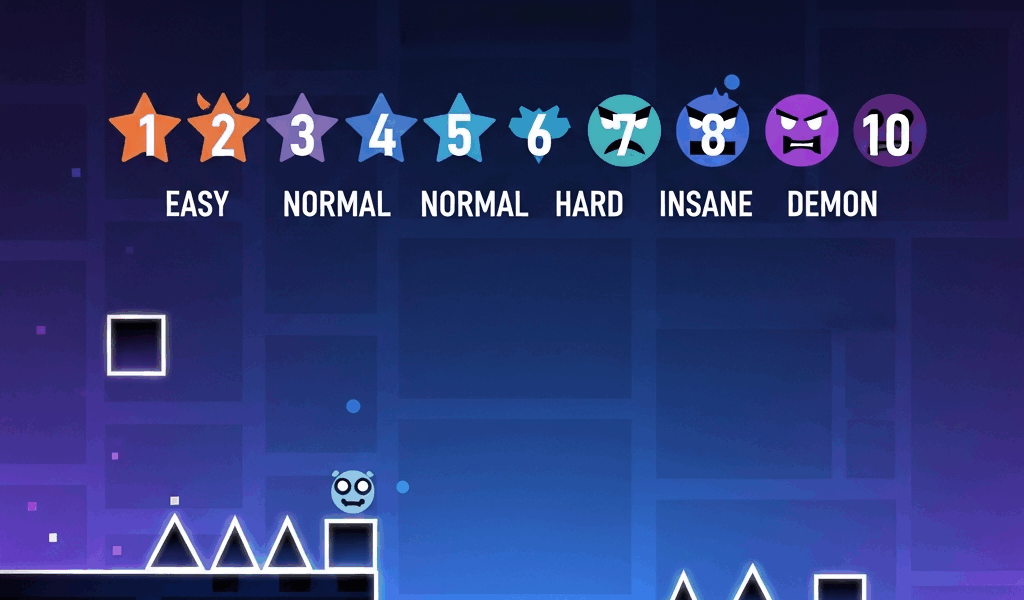
The Geometry Dash difficulty rating system determines everything from the stars you earn to the challenges you pursue. Understanding this system thoroughly helps you track progress, find appropriate levels, and set meaningful goals. This comprehensive guide breaks down every aspect of GD difficulty from Auto to Extreme Demon.
How Difficulty Ratings Work
Geometry Dash uses a two-part rating system: difficulty face (the icon showing how hard a level is) and star rating (1-10 stars awarded upon completion). RobTop and volunteer moderators assign these ratings based on player feedback, comparison to existing levels, and overall difficulty assessment.
Ratings aren’t permanent – they can be adjusted if community consensus suggests a level is mis-rated. This happens most often in demon tiers where small difficulty differences significantly impact player experience.
Non-Demon Difficulty Tiers
Auto (1 Star)
Auto levels require no player input – they play themselves through trigger mechanisms, moving objects, and automatic progressions. While completing them requires no skill, creating impressive auto levels demands significant technical knowledge.
Auto levels serve various purposes:
- Decoration showcases demonstrating visual techniques
- Musical visualizers synced to soundtracks
- Story-driven experiences or animated sequences
- Technical demonstrations of trigger capabilities
Easy (1-2 Stars)
Easy levels introduce basic controls with extremely forgiving timing windows. These exist primarily for complete beginners learning how to tap/click and understanding fundamental mechanics like jump pads and portals.
Characteristics of Easy levels:
- Wide timing windows for jumps
- Minimal or no ship/wave sections
- No complex sequences or memorization required
- Simple, readable decoration that doesn’t obscure gameplay
Normal (2-3 Stars)
Normal levels introduce slightly more complexity while remaining accessible. You might encounter basic ship sections, simple ball segments, or timing challenges that require paying attention rather than just mashing.
Players should comfortably clear Normal levels before progressing. If Normal feels challenging, continue practicing fundamentals before attempting harder content.
Hard (4-5 Stars)
Hard levels mark the first real challenge tier. Expect:
- Tighter timing requirements
- Introduction of wave and spider modes
- Faster speed sections
- Sections requiring learning rather than pure reaction
Many casual players plateau at Hard difficulty initially. Breaking through requires dedicated practice and understanding that failure is part of improvement.
Harder (6-7 Stars)
Harder levels challenge intermediate players with complex patterns and tighter execution requirements. These levels often introduce:
- Extended ship or wave corridors
- Dual sections (controlling two icons)
- Speed changes mid-level
- Memory elements requiring multiple attempts to learn
Successfully completing Harder levels consistently indicates readiness to attempt Insane content.
Insane (8-9 Stars)
Insane levels represent the ceiling of non-demon difficulty. These levels demand significant skill investment and typically feature:
- Tight corridors with minimal margin for error
- Fast-paced sections requiring quick reactions
- Complex game mode transitions
- Extended difficult sections without breaks
Most featured levels fall into the Insane category. Consistently beating Insane levels prepares you for Easy Demons.
Demon Difficulty Tiers
Demon levels represent the serious challenge tier of Geometry Dash. All demons award 10 stars upon completion regardless of sub-tier, but the difficulty range within demons is enormous – greater than the entire non-demon spectrum combined.
Easy Demon
Entry-level demons bridge the gap from Insane-rated levels to true demon gameplay. While still challenging, Easy Demons are achievable for players who consistently beat Insane levels.
Easy Demon characteristics:
- Difficulty slightly above hardest Insane levels
- Generally forgiving timing compared to higher demons
- Usually beatable in under 1000 attempts for prepared players
- Examples: The Nightmare, The Lightning Road, Platinum Adventure
Medium Demon
Medium Demons represent a noticeable step up requiring more consistency and typically featuring longer, more complex levels. The gap between Easy and Medium is where many players get stuck.
Medium Demon characteristics:
- Require passing difficult sections multiple times without mistakes
- Often longer than Easy Demons
- Introduce more demanding patterns
- Examples: B, Deadlocked, Decode
Hard Demon
Hard Demons mark where demon difficulty gets serious. These levels demand real skill development and significant practice time. Completing Hard Demons marks you as a genuinely skilled player.
Hard Demon characteristics:
- Tight timing windows throughout
- Fast sections requiring trained reflexes
- Passages needing dozens of practice attempts to learn
- May require hundreds or thousands of total attempts
- Examples: Nine Circles, Fairydust, Windy Landscape
Insane Demon
Insane Demons are expert-level content reserved for experienced players. The jump from Hard to Insane Demon is substantial – many players who breeze through Hard Demons hit a wall here.
Insane Demon characteristics:
- Extremely demanding sections throughout
- May require thousands of attempts
- Often include memory sections or precise timings
- Only a small percentage of players complete Insane Demons
- Examples: Cataclysm, Aftermath, Windy Landscape
Extreme Demon
Extreme Demons represent the absolute ceiling of human capability in Geometry Dash. These levels push physical and mental limits, with top players spending months on single verifications.
Extreme Demon characteristics:
- Near-frame-perfect inputs required
- Extended sections of maximum difficulty
- Verification attempts may reach 100,000+
- Completed by a tiny fraction of the playerbase
- Examples: Bloodbath, Zodiac, Slaughterhouse

How Ratings Are Assigned
RobTop and volunteer moderators assign ratings based on multiple factors:
Player Feedback
Community reports on difficulty and death statistics inform rating decisions. If many players report a level feels harder or easier than its current rating, moderators investigate.
Comparison to Existing Levels
New levels are compared to established benchmarks at each difficulty tier. A level earning a Hard Demon rating should feel similar in difficulty to other Hard Demons.
Difficulty Consistency
Levels with major difficulty spikes (easy sections followed by impossible sections) may receive higher ratings than their average difficulty would suggest, since players must survive the hardest parts.
Community Consensus
For controversial ratings, moderators consider widespread agreement among skilled players. If the community broadly agrees a level is mis-rated, adjustments happen.
The Star System and Progression
Completing rated levels earns stars based on difficulty:
- Auto/Easy: 1-2 stars
- Normal: 2-3 stars
- Hard: 4-5 stars
- Harder: 6-7 stars
- Insane: 8-9 stars
- All Demons: 10 stars
Accumulated stars unlock icons, colors, ships, trails, and other customization options. The progression system provides concrete goals beyond just completing levels.
Star Milestones
Significant unlocks happen at various star counts. Players often set goals around these milestones, grinding rated levels to reach the next reward tier.
Creator Points and Level Quality
When your created level gets rated by moderators, you earn Creator Points (CP). The amount depends on the rating:
- Rate: 1 CP
- Feature: 2 CP
- Epic: Additional CP
High CP counts unlock special creator badges and recognition. The creator leaderboard ranks players by accumulated CP, showcasing the most prolific quality creators.
Understanding Your Progression
Benchmarking Skill
Use difficulty ratings to honestly assess your current skill level:
- Struggling with Hard levels: Focus on fundamentals and practice all game modes
- Comfortable with Insane: Ready to attempt Easy Demons
- Beating Easy Demons consistently: Progress to Medium Demons
- Completing Hard Demons: You’re in the top percentage of players
Setting Goals
Meaningful goals align with difficulty tiers:
- Short-term: Complete a specific level or beat your first demon
- Medium-term: Clear all official levels or reach a demon count milestone
- Long-term: Push into higher demon tiers or verify your own demon
Understanding the difficulty system helps you set realistic, achievable goals that maintain motivation while building skills progressively.
Related Articles
Continue reading:

Leave a Reply