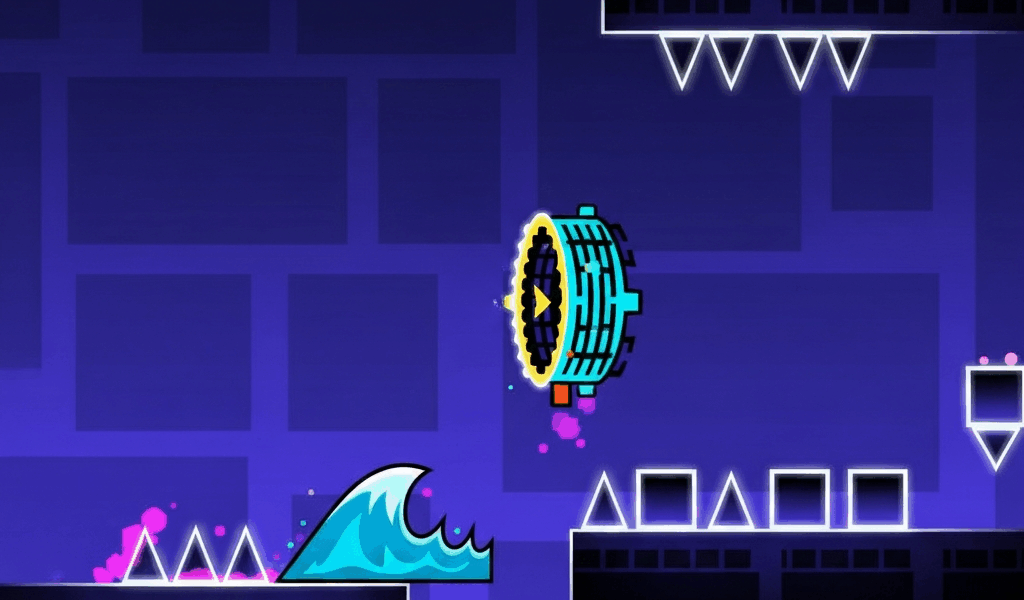
Wave mode is widely considered the most demanding game mode in Geometry Dash. The constant diagonal movement, unforgiving corridors, and requirement for perfect precision make it a true test of player skill. Many experienced players who breeze through ship and ball sections still struggle with wave. Here’s a comprehensive guide to understanding and mastering this challenging mechanic.
How Wave Mode Works
The wave operates on simple but demanding physics: hold your input to move diagonally upward at a 45-degree angle; release to move diagonally downward at the same angle. Unlike ship mode, the wave never travels horizontally. It’s always moving up or down relative to the screen.
This constant diagonal movement means you can’t simply “stop” to assess a situation. The wave demands continuous input management and constant decision-making about which direction to travel next.
Core Concepts for Wave Mastery
Understanding the Neutral Line
In theory, rapidly alternating between hold and release creates roughly horizontal movement. In practice, you’ll produce slight oscillations – small ups and downs that average out to forward progress. Learning to maintain a steady height through this controlled oscillation is fundamental to wave success.
The goal isn’t perfectly straight movement (which is nearly impossible) but rather controlled oscillation within the available corridor space.

Navigating Tight Corridors
Wave corridors are often extremely tight – sometimes just 2-3 blocks of vertical clearance. You must react instantly to path changes while maintaining precise altitude control. Unlike ship mode where you have time to correct mistakes, wave errors typically result in immediate death.
The key is anticipation rather than reaction. Read the corridor ahead and begin adjusting before you reach direction changes, not as you encounter them.
Speed Dynamics
Wave feels completely different at various speeds. Slow wave gives you more time to think but feels sluggish and requires longer holds/releases to cover vertical distance. Fast wave demands instant reactions but is actually somewhat more forgiving on timing since you spend less time in dangerous positions.
Many players initially find slow wave harder because mistakes have more time to compound. Others struggle with fast wave’s reaction demands. Understanding your personal difficulty pattern helps focus practice.
Essential Practice Techniques
Straight Wave Drill
Find or create a practice level with extended straight corridors at constant height. Focus on maintaining perfectly horizontal movement as long as possible. This builds the fundamental tap rhythm needed for all wave gameplay.
Transition Training
Practice entering and exiting wave mode cleanly. The moment of transitioning through a wave portal is often where players die – they misjudge their initial trajectory or release timing. Specifically drill the first second after entering wave mode.
Mini Wave Specialization
Mini wave moves faster through tighter spaces with more responsive controls. It amplifies all wave challenges. Dedicated mini wave practice helps because skills transfer to regular wave with room to spare.
Types of Wave Sections
- Spam sections – Rapid input alternation through corridors requiring high-frequency tapping
- Memory wave – Paths that are invisible or obscured, requiring memorization from practice
- Asymmetric dual wave – Two waves simultaneously with different paths, among the hardest content in GD
- Slow wave precision – Tight corridors at reduced speed demanding patient, controlled movement
- Direction change corridors – Paths that alternate between requiring upward and downward movement

The Mental Game
Wave mode frequently causes the most frustration among GD players. The precision required and instant death punishment can trigger tilt states that make performance worse. Managing your mental approach is as important as mechanical practice.
Stay physically relaxed. Tensing up – gripping your device harder, hunching shoulders, holding breath – makes your movements jerky and imprecise. Consciously relax your hand and maintain steady breathing.
When frustration builds, step away before it affects your performance. Wave skill degrades rapidly when you’re tilted. A five-minute break often accomplishes more than twenty minutes of frustrated grinding.
Progress Expectations
Wave mastery typically takes months of dedicated practice, not days or weeks. The good news is that improvement, while slow, is steady. Skills you build in wave transfer to overall game performance and make you a more complete player.
Celebrate small wins: slightly longer survival times, cleaner section completions, reduced deaths in familiar areas. Wave progress is measured in increments, and acknowledging improvement maintains motivation during the long learning curve.
Related Articles
Continue reading:

Leave a Reply