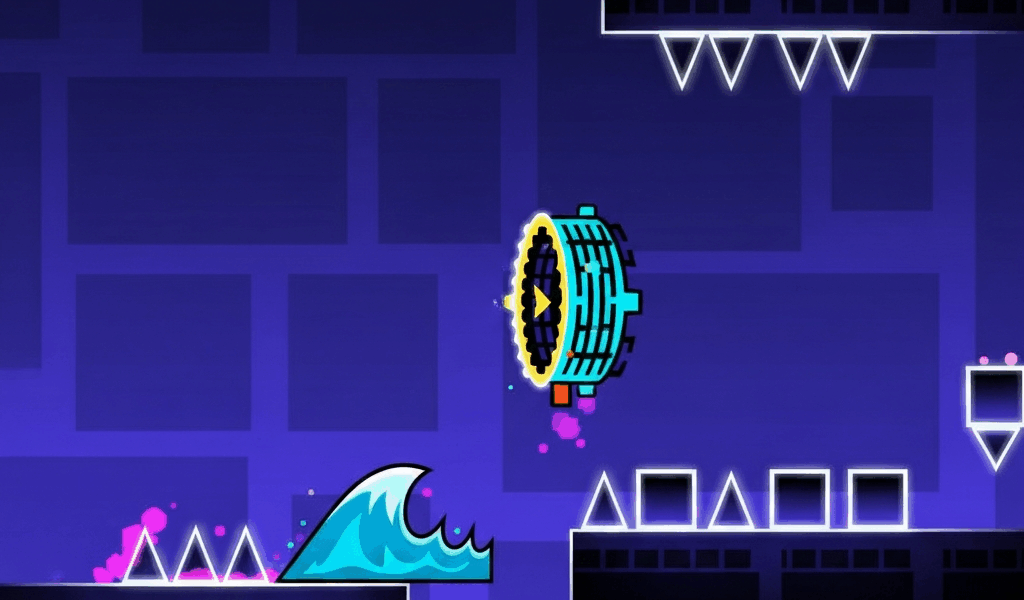
Wave mode has gotten a bad reputation with all the rage-quit compilations flying around. As someone who’s dumped probably 400+ hours into this game and died in wave sections more times than I can count, I learned everything there is to know about surviving those brutal corridors. Today, I will share it all with you.
Here’s the thing nobody tells you upfront: wave isn’t actually the hardest mode mechanically. It just punishes hesitation harder than anything else in GD. I used to think I was bad at wave. Turns out I was just tense.
How Wave Mode Actually Works
Hold your input, you go diagonally up at 45 degrees. Release, you go diagonally down at the same angle. That’s it. No horizontal movement ever. The wave is always moving up or down relative to the screen, and that constant diagonal motion is what makes your brain panic.
You can’t pause to think. You can’t hover in place like ship mode. Every millisecond you’re either climbing or diving, and the corridors don’t care about your feelings.
The Neutral Line Thing That Changed Everything for Me
Rapidly alternating between hold and release creates roughly horizontal movement. In theory. In practice, you get these tiny oscillations — little bumps up and down that average out to forward progress. Took me weeks to realize that perfectly straight movement isn’t the goal. Controlled wobble within the corridor space? That’s the goal.
Probably should have led with this, honestly.
Once I stopped trying to fly perfectly straight and just accepted the wobble, my wave survival rate went up dramatically. Like, immediately.

Tight Corridors Will Humble You
Some wave corridors give you maybe 2-3 blocks of vertical clearance. That’s nothing. In ship mode you’d have room to breathe and correct. In wave? One bad tap and you’re dead before your brain even registers what happened.
The trick I picked up from watching Npesta’s streams is anticipation over reaction. You need to read the corridor ahead and start adjusting before you reach direction changes. Not as you hit them. Before. If you’re reacting to what’s directly in front of you, you’re already too late.
Speed Changes Everything
I’m apparently one of those weird players where slow wave is harder than fast wave. Slow wave gives you more time to think, sure, but your mistakes have more time to compound. You hold a fraction too long at 1x speed and you’ve drifted way off course. At 3x or 4x speed, that same hold barely moves you.
Fast wave demands instant reactions but is actually somewhat more forgiving on positioning since you spend less time in each dangerous spot. Plenty of people disagree with me on this. Figure out which speed kills you more and drill that one specifically.
Practice Drills That Actually Help
The Straight Line Drill
Find a practice level with extended straight corridors at constant height. I used to load up a custom level someone made called “Wave Practice v3” (search for it, there are dozens like it) and just try to hold a flat line for as long as possible. Boring? Absolutely. But it builds the fundamental tap rhythm you need for everything else.
Portal Transition Training
The moment you enter a wave portal is where half the deaths happen. You misjudge your initial trajectory, you panic on the first tap, and boom. Dead. Specifically drill the first second after entering wave mode. That transition window is a skill all by itself.
Mini Wave — The Real Boss
Mini wave moves faster through tighter spaces with more responsive controls. It takes every wave challenge and cranks it up. But here’s why you should practice it anyway: skills transfer to regular wave with room to spare. If you can survive mini wave corridors, regular wave starts feeling almost relaxed.
Types of Wave Sections You’ll Run Into
- Spam sections — rapid input alternation through corridors that need high-frequency tapping. Your finger will hurt.
- Memory wave — paths that are invisible or obscured, so you’re flying blind from memorization. Brutal but satisfying once you nail them.
- Asymmetric dual wave — two waves simultaneously with different paths. Among the hardest content in all of GD. Period.
- Slow wave precision — tight corridors at reduced speed demanding patient, controlled movement. My personal nemesis.
- Direction change corridors — paths that alternate between requiring upward and downward movement, testing your ability to switch rhythms on the fly.

Your Brain Is the Problem (Not Your Fingers)
That’s what makes wave mode endearing to us GD players — it’s the one mode where your mental state matters more than your mechanical skill.
Wave causes the most frustration out of any mode. The precision required combined with instant death can trigger tilt states that snowball fast. I’ve had sessions where I could nail a section 10 times in practice mode, then die to it 30 times in a row during real attempts because I was tensed up and breathing wrong.
Stay physically relaxed. Seriously. I catch myself gripping my phone harder, hunching my shoulders, holding my breath — all of which make my movements jerky and imprecise. Consciously relax your hand. Breathe normally. It sounds dumb but it works.
When frustration starts building, walk away. Five minutes doing literally anything else accomplishes more than twenty minutes of angry grinding. I learned this the hard way after throwing my phone across the room during Sonic Wave attempts. Don’t be me.
How Long This Actually Takes
Wave mastery takes months. Not days. Not weeks. Months of dedicated practice. I don’t say that to discourage you — I say it so you don’t feel broken when you’re still struggling after two weeks.
The good news? Improvement is steady even when it doesn’t feel like it. Skills you build in wave transfer to everything else and make you a more complete player across every mode.
Celebrate the small stuff. Slightly longer survival times. Cleaner section completions. One fewer death at that spot that always gets you. Wave progress is measured in tiny increments, and noticing those increments keeps you going during the long grind.
Related Articles
Continue reading:

Leave a Reply