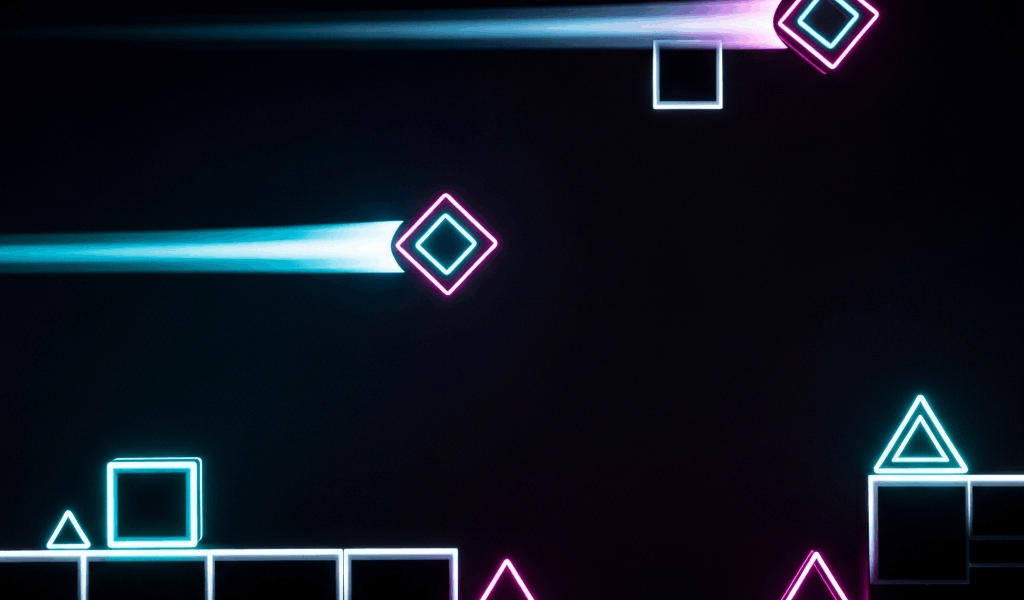
Straight flying is holding your ship or UFO in a perfectly horizontal line through a tight corridor without drifting up or down. That’s it. Simple concept, brutally hard execution. It’s the single skill that separates players who can beat Hard Demons from players who get stuck on them forever.
I spent an embarrassing amount of time thinking straight fly sections were just “hold and pray” moments. They’re not. There’s a real, learnable technique behind it, and once it clicks, you’ll wonder how you ever struggled with it.
What Straight Flying Actually Is
In ship mode, your icon naturally wants to rise when you hold and fall when you release. Straight flying means counteracting that gravity cycle so precisely that your ship travels in a near-perfect horizontal line. Most corridors that require it give you maybe 2-3 blocks of vertical space to work with. Some give you less.
The reason it’s so hard comes down to physics. The ship in Geometry Dash doesn’t have a hover state. You’re always either accelerating upward or falling downward. There’s no “neutral.” So maintaining a straight line means you’re constantly making micro-corrections — tiny taps that bump you up just enough to offset gravity, then releasing for just long enough to let gravity pull you back down a pixel or two.
What makes this different from normal ship gameplay is the margin of error. In a regular ship flying section, you’ve got room to wave up and down a bit. Straight fly corridors punish any visible oscillation. The wave pattern of your movement needs to be so tight that it’s essentially invisible.
Probably should have led with this, honestly — straight flying also applies to UFO mode sections and even some wave corridors, though ship mode is where most players encounter it first and where the technique matters most.
The Core Technique
Here’s the actual method. Forget everything you think you know about ship control and focus on three things: tap rhythm, visual anchor point, and relaxation.
Tap Rhythm
You’re not holding the screen. You’re not clicking and releasing in big chunks. You’re doing rapid micro-taps — think 4 to 8 taps per second depending on the speed of the section. Each tap is barely a tap. You’re brushing the screen or clicking the mouse so lightly and quickly that your finger almost vibrates.
The rhythm isn’t random either. It should be steady, almost like a drummer keeping time. Tap-tap-tap-tap at a consistent pace. When you need to drift slightly up, you hold one of those taps a fraction longer. When you need to drop, you extend the gap between taps slightly. But the base rhythm stays constant.
On PC, a lot of players find it easier to use a mouse click rather than spacebar because you can control the pressure and duration more precisely. On mobile, use your index finger rather than your thumb — you get better fine motor control that way.
Visual Focus Point
This one changed everything for me. Don’t watch your ship icon. Watch the space about 2-3 blocks ahead of your ship. Your peripheral vision will track your ship’s vertical position, but your direct focus should be on where you’re going, not where you are.
It’s counterintuitive. Every instinct says to stare at your icon. But when you focus slightly ahead, your brain processes the corridor width and your position within it more naturally. You start making adjustments before you need them instead of reacting after you’ve already drifted too far.
Relaxation
Tension kills straight fly attempts faster than anything else. When your hand tenses up, your taps become irregular and too forceful. I know it sounds ridiculous to say “just relax” during the hardest part of a Demon level, but it genuinely matters. Keep your grip loose. Breathe. If you notice your hand cramping or your shoulder tightening, that tension is translating directly into jerky inputs.
Some players shake out their hands between attempts. That’s not a bad habit. The physical component of straight flying is real, and treating it like a mental and physical endurance challenge rather than just a reaction test makes a difference.
Best Practice Levels for Learning
You can’t learn straight flying by throwing yourself at the straight fly section of a Hard Demon over and over. You need isolated practice. Here are levels specifically built for that.
Straight Fly Training by Raxis — This is the one most people start with. It gives you progressively narrower corridors and builds up from generous spacing to extremely tight gaps. The pacing is great for building confidence.
Straight Fly Challenge by Krazyman50 — A step up in difficulty. Krazyman50 designed this with consistent corridor widths and longer sections so you can really develop sustained rhythm. It’ll expose any inconsistency in your tapping.
Ship Challenge by Ryder — Not exclusively straight fly, but the ship sections are excellent for developing the control you need. Good for transitioning from isolated practice to real gameplay scenarios.
Straight Fly Test by Zobros — On the harder end. Tight corridors with some speed changes that force you to adjust your tap rhythm on the fly. Don’t start here, but once you’re comfortable with the basics, this level will push you.
The approach that worked for me: spend 15-20 minutes on a training level at the start of each session as a warmup. Don’t grind it for hours. Your muscle memory develops better in short, focused bursts spread across multiple days than in one marathon session. After warmup, go play actual levels and apply what you’ve practiced.
Using practice mode strategically helps too — drop checkpoints right before straight fly sections in real levels so you can repeat just that segment without replaying the entire level each time.
Common Mistakes That Kill Your Runs
Over-correcting
This is the big one. You drift up slightly, panic, stop tapping entirely, drop too far, panic again, hold too long, hit the ceiling. The death spiral happens because each correction is too large. When you notice yourself drifting, the adjustment should be almost imperceptible — one slightly longer or shorter tap, not a dramatic change in rhythm.
Rushing the Rhythm
When a straight fly section starts, a lot of players immediately speed up their tapping out of anxiety. Faster isn’t better. Consistent is better. Match your tap speed to the game speed. At 1x speed, your tapping should be moderate. At 2x or 3x, yes, you’ll need faster inputs. But a lot of straight fly sections in rated levels happen at normal speed, and players tap way too fast for the physics.
Playing at the Wrong FPS
This matters more than most players realize. Geometry Dash’s physics are tied to frame rate. At 60 FPS, the ship’s gravity response is different than at 240 FPS. Higher frame rates actually make straight flying easier because the gravity increments per frame are smaller, giving you finer control. If you’re on PC and playing at 60 FPS, consider bumping it up. The difference at 144 or 240 FPS is noticeable immediately.
On mobile, you’re locked to whatever your device outputs, which is usually 60 FPS. That’s fine — plenty of incredible players straight fly on mobile. But know that if you switch between mobile and PC, the feel will be different and you’ll need a brief adjustment period.
Ignoring the Music
Geometry Dash is a rhythm game at its core. Many straight fly sections are synced to the music, and if you tap in time with the beat, your rhythm becomes more consistent naturally. Not every section lines up perfectly, but when it does, use that audio cue. It’s free help.
Starting Practice Too Late
Don’t wait until you hit a wall in a level to start working on straight flying. Build it as a fundamental skill early. Players who spend even a few minutes per session on ship control training progress through Demon levels significantly faster than those who try to learn it on the spot.
When Straight Fly Sections Appear in Real Levels
Straight fly isn’t just a training exercise. It shows up constantly in rated levels, especially from Hard Demon difficulty onward. Here’s where you’ll encounter it.
Clubstep (Insane Demon) — The ship sections in Clubstep aren’t pure straight fly, but they demand enough precision that the technique directly applies. It’s where a lot of players first realize they need this skill.
Nine Circles by Zobros — The wave section gets all the attention, but the ship portions require tight control that benefits enormously from straight fly fundamentals.
Windy Landscape by WOOGI1411 — Has a notoriously precise ship section that’s essentially a straight fly gauntlet. Many players cite this as the hardest part of the level.
Bloodbath by Riot and others — Multiple straight fly sections across this iconic Extreme Demon. The margin for error is almost non-existent. This is where mastery of the technique gets tested at the highest level.
Cataclysm by Ggb0y — The opening ship section is one of the most well-known straight fly tests in the game. Thousands of players have died in the first 10% of this level specifically because of it.
As you progress into Insane Demon and Extreme Demon territory, straight fly becomes less of a special challenge and more of a baseline expectation. Creators assume you can do it, and they build levels accordingly.
Putting It Together
Straight flying isn’t a trick you learn once. It’s a skill you maintain. Even experienced players warm up their ship control before serious attempts. The good news is that the technique transfers across every game mode that involves flying — ship, UFO, and wave all benefit from the same micro-tap discipline and visual focus habits.
Start with the training levels. Focus on rhythm over speed. Keep your eyes ahead of your icon. Stay loose. And give yourself permission to be bad at it for a while. Everyone is, at first. The players who make it look effortless just put in the reps when nobody was watching.


Leave a Reply