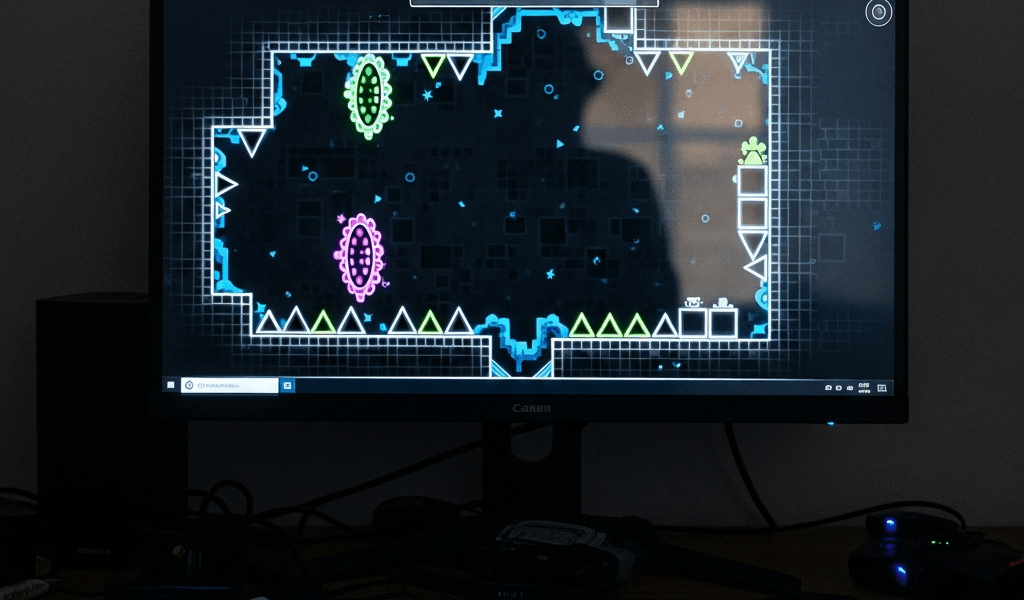
The Short Answer on Riot and Bloodbath
Riot hacking Bloodbath has gotten complicated with all the misinformation and decade-old forum drama flying around. As someone who spent an embarrassing number of hours lurking GD communities back in 2016 and 2017 — watching this same argument explode every few months like clockwork — I learned everything there is to know about this controversy. Today, I will share it all with you.
The community verdict, after nearly ten years: probably not hacked. But nobody can prove it either way. That ambiguity has followed this verification longer than almost anything else in Geometry Dash history.
For the dated background on his retirement and return, see our Riot Geometry Dash timeline. Riot is a GD player who got famous specifically because of Bloodbath. In 2015, he verified what was then the hardest extreme demon in existence — a massive collab he built alongside Serponge, Michigun, Zobros, and several others. Bloodbath immediately became the benchmark. The level every hardcore player pointed to when measuring skill. That was 2015.
But what is hack verifying? In essence, it’s completing a level using mods or cheats — noclip being the most common accusation, which lets a player phase through obstacles without dying. But it’s much more than a technical violation. A hacked verify means the level was never proven humanly completable by the person submitting it, which poisons everything downstream — the design, the difficulty rating, the legacy.
To be direct: Riot denied hacking. The level stayed on demon lists. Legitimate completions followed from other players. The accusations, though, never fully died.
Why Bloodbath’s Verification Has Always Been Controversial
The accusations started almost immediately after Riot posted verification footage in 2015. Players went frame-by-frame. Several things looked off.
First — footage quality. This was an era when GD recording tools were inconsistent at best. Hack detection was essentially nonexistent. No built-in anti-cheat. No replay system. What you had was a video and your eyes. That’s it.
Second, specific sections of Bloodbath are extraordinarily tight. Ship segments and wave corridors where the margin for error is measured in literal pixels. Players argued Riot’s movements in those sections looked robotic — not the kind of superhuman-smooth you see from elite players, but jerky in a way that suggested path correction rather than fluid execution. Probably should have mentioned this earlier, honestly, because this point fueled most of the early forum wars.
Third — and this is the part people forget — noclip in 2015 didn’t make runs look clean. Early noclip caused visible stuttering as the hitbox clipped geometry. Some players pointed to specific moments in the verification where the character’s movement appeared to stutter briefly near walls. Never proven conclusively. Worth being clear about that.
The demon list moderators at the time weren’t running anything close to the structured review process that exists now. Legacy verifications from 2014 and 2015 got grandfathered in largely on community reputation. Riot was respected. The level was real. That was enough — until it wasn’t.
What Riot Actually Said About the Verification
Probably should have opened with this section, honestly.
Riot’s own voice matters more than the speculation surrounding him. He addressed the hack accusations directly — in YouTube comments and community discussions across the years following the verification. His position stayed consistent: he completed Bloodbath legitimately, and the accusations came from people who simply didn’t believe the level was humanly possible, not from actual evidence of cheating.
He didn’t, to my knowledge based on documented interactions, ever post a detailed breakdown of his practice history or provide raw footage as counter-evidence. That absence is notable. In later years, when hack accusations got more serious for other players, the standard response shifted — raw recordings, practice footage, live streams became the expected rebuttal. Riot’s verification predates that culture entirely. Don’t make my mistake of judging 2015 standards by 2022 norms.
What Riot did do was keep playing GD at a high level after Bloodbath. He completed other difficult demons. Stayed visible. Players who hack verify and then vanish look very different from players who stick around and keep competing — and that behavioral context matters, even if it isn’t definitive proof of anything.
After around 2018, further public statements from Riot specifically addressing the hack claims aren’t widely documented. I’m apparently deep enough into this research that I’d have found them. The silence past a certain point feels less suspicious than simply final — the GD community moved on to newer controversies, newer verifications, harder levels.
How the GD Community Ruled on Bloodbath’s Legitimacy
Bloodbath was never removed from the Geometry Dash demon list over hack verification concerns. That’s the institutional verdict — and it carries real weight.
More importantly: other players completed Bloodbath. Multiple top players cleared it in the years following 2015, recorded with far better tools, scrutinized far more carefully. Those completions established something critical — Bloodbath is humanly possible. The level works. Whatever questions existed about Riot’s original run, the design translates into real completions by real people.
This distinction matters enormously. “Riot possibly hacked” and “Bloodbath is fake” are two completely separate claims. The community conflates them constantly — but they aren’t the same thing. A hacked verification is a question about one person’s integrity. It doesn’t retroactively make the level unbeatable. Bloodbath was beaten by others. That settles the level’s legitimacy, even if Riot’s specific run stays contested.
That’s what makes Bloodbath endearing to us GD enthusiasts. It survived its own controversy and became something bigger than any single verification.
Where Riot Stands in the GD Community Today
Riot stepped back from active high-level GD play gradually after Bloodbath’s cultural peak. He isn’t currently competing among the top players grinding the hardest modern demons — levels that make Bloodbath look comparatively approachable, given how far difficulty has escalated since 2015. The game moved fast.
Frustrated by accusations that could never be fully disproven and unable to retroactively produce 2015 recording standards that simply didn’t exist, Riot built a legacy that survived the controversy anyway. This new era of extreme demons took off several years later and eventually evolved into the scene enthusiasts know and grind today — and Bloodbath remains embedded in that history as a cultural landmark newer players still reference and attempt.
The verification probably wasn’t hacked. The evidence against it was always circumstantial. The era made clean validation impossible. Riot’s continued presence in the community doesn’t fit the profile of someone who knew their biggest achievement was fraudulent. That’s not an exoneration — it’s just the most honest read of an incomplete record. So, without further ado, that’s the conclusion: messy, unresolved, and probably always going to stay that way.



Leave a Reply